Thursday, September 6, 2007

FEBRUARY 28, 2007

We are crippled by the rain. Today we were scheduled to relocate to another camp, and we can’t. The grumbling begins, not because anyone is being difficult—in fact the gang is remarkable easy—but the situation is tough and wearing on our spirits. The lid is on the pot.

The morning sky looks badly bruised, with angry welts of dark gray, as if each clap of clamorous thunder through the night was a punch.

We do a school that we found on the fly since our itinerary was supposed to have us out of the area today. We’ve done a few schools by now, so the machinery is well-oiled and people fall into a pattern of tasks. The entire school—a few hundred, lines up. They dance and sing for us, we de-worm and distribute. We have it down to a bit of a science now. Their faces remain magical.

After we get back from the school, the rain has paused this morning so we do group yoga in the wet sand. Stretching, moaning, bored and looking for something to occupy us. Each of us contributes our own stretch suggestions, and we all get a pretty good, if inexpert, stretch. The mood is lackadaisical. Some have drifted away to their tents to read or nap. Some are fidgety. The group that gathered for yoga does some cursory chakra chanting, which is quite grounding.

No matter how grounded we get, the actual ground…and we…are wet, wet, wet.

The horses are on the verge of getting ill, unused as they are to standing, unprotected, in day after day of rain. If one horse gets strangles or pneumonia, it will pass through the pack as rapidly as we humans are passing around this flu I have a touch of…but the horses probably wouldn’t survive it. As a precaution, the grooms burn a mixture of herbs in the bottom of a galvanized steel bucket that smokes terrifically, then go from horse to horse, holding it up to their muzzle, making them breathe in the healing smoke. Some seem to recognize that it is therapeutic and lower their heads to inhale calmly, others are confronted and rear away, tossing. It is fascinating, and another of many examples of how loved and well taken care of these Marwari horses are.

Bonnie—the head honcho of the horse company—arrives at our little lost outpost late in the night. He is a formidable man with a great silver moustache and aristocracy written all over him. Like the Thakur of Tantwas, Bonnie is the prince-like leader of many villages. I’m told he has about twice as many villages in his domain as the Thakur. He smiles broadly, and truly seems to enjoy providing the horse experience for foreign guests. He and Sunayna have many deep conversations. Alexander is in on some, but has to leave to drive several hours to pick up the dentist who is volunteering at the all-day medical camp we will do tomorrow (weather permitting). At some point, among dozens of variable plans, only a couple of which we are privy to, the actual one we will take has emerged. We spent the afternoon in and out of the common mess tent and our own tents, spells of torrential rain beating down and re-soaking everything, watching brilliant lightning shows across the horizon and a late afternoon double rainbow, while the powers-that-be made up their minds. After tomorrow’s medical camp, the horses will be loaded into a trailer, our wet and muddy camp will be broken, and we will be loaded into a bus for a 5-hour drive to Dundlod Fort, Bonnie’s ancestral home and the home base/stables for the horses. This is where most of the previous RRI rides have been based.

The news disappoints some of us, and thrills a few who were closer to the end of their rope than I had realized. I think I had found some sort of peace with he weather—reveling in the drama of it. I was as wet and damp as anyone (except perhaps Charlene and Curtis from their private flood) but it seems in hindsight I was less disgusted by these particular challenges than some. That’s not a better/worse judgment call…I had just not wrapped my head around the possibility that moving elsewhere was possible. I had felt a little under the weather and evidently slept through a group meeting where this was discussed, so I was surprised to learn we were moving…retreating actually.

My biggest concern was the villagers where we were expected to distribute livestock. If we abandoned this itinerary, and this entire region, what would come of their expectation and planning on receiving goats? The village leader had been told, families notified goats were forthcoming, a goatherd contacted and he had already assembled the goats for us…were we leaving them in the lurch? The group is given two options: either we can do goat distribution at a village near Dundlod where we are headed, or we can arrange for the villagers who were planning on receiving them here to simply receive them without the pomp and circumstance of us being the ones to actually hand them over in a village ceremony. I am heartened to see that we agree to get the goats to the folks who had begun to build their plans and expectations on getting them. If the livestock can truly change the lives of the recipient, I hate to think what being promised such a change, then having it ripped away would have done.

We retire mellowed, each of us with some level of relief, I’m sure. At least Bonnie and Sunayna have a plan, and decisive action will be taken. We are concerned nobody will come for the medical camp tomorrow since the weather is so extreme, but we are hopeful and dedicated to honoring that commitment, come hell or, inevitably, high water.

MARCH 1, 2007

MEDICAL CAMP-SUKHVASI
We wake to the dawn of an ironically cool, perfectly clear day. We eat breakfast and are told to pack and have our suitcases outside our tents soon, as camp is already being broken around us. Wet mattresses and bedding are piled on top of wet cots. The kitchen and staff tents are down. Trucks are being loaded.

We jeep into Sukhvasi, where the local school (again, empty rooms of cinderblock) has been set up for the medical camp. A large, patterned fabric covering has been strung up over the courtyard formed by the elbow of the L-shaped building, casting a red glow on the waiting area. We unload and are given job assignments. “Intake” sits with a translator to get patients’ name, age, and complaint, which are recorded in a log book as well as on a routing slip piece of paper the patient will carry with them and present at the appropriate doctor’s station. Most will see more than one doctor. “Dispensary” workers from our group fill small dosage bottles of syrups and lotions from giant jugs as well as count out pills for distribution—the prescribe-able medicines list given to the doctors has probably 20 medicines on it that we supply. The “Bananas and Oranges” team hands these out to a community whose diet comprises mainly onions and millet. “Triage” helps direct and control traffic, and there is a “Door” person assigned to each doctor. There are pediatricians, a GP, eye specialist, Ear/Nose/Throat specialist, and a dentist. All but the dentist are local volunteers from the medical community—the dentist, Dr. Vivek, has volunteered with Alexander at each camp and travels to meet the rides wherever they are.

We had been told earlier that the assistants to the dentist would have to have a strong stomach since there can be blood as he occasionally has to do extractions on the spot. I’ve previously expressed interest in this so I can feel as “immersed” as possible—little did I know that about half a dozen others were of the same mind. As Alexander asks for volunteers for other posts, people head off to their stations, and the six of us steadfastly wait for him to call for volunteers for the dentist—seems we’re a bloodthirsty lot. Two of us are eventually chosen, Rebecca and I, but Rebecca is called back and replaced with Barry. Once we get to the room and meet with Dr. Vivek, Barry too is sent away as the doctor only requires one assistant.

Dr. Vivek has a periodontal and implant surgery specialty practice in Jaipur, and has been doing the camps with Alexander since the beginning of RRI. He is great and very no-nonsense. Our “office” is an electricity-free empty classroom with swirls of blown dust in the corners of the cement floor and birds flying in and out of the glassless windows. A small table is set up with a model mouth and oversize toothbrush; an illustrated standing flip chart explaining cavities; several boxes of antibiotics and topical oral pain relievers; a few bottles of xylocaine and other injectibles; a dental hand mirror; the doctor’s bag. He sits in one mud-stained molded plastic patio chair and we have a second chair for the patient. I run out to the jeep to fish out my LED headlamp for the doctor since he has no light source anywhere in the room but the murky, indirect light bleeding through the windows (around the cooing pigeons).
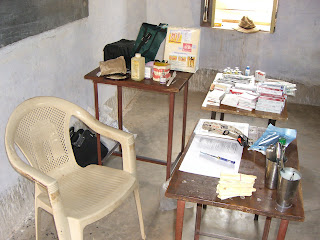
As people start to arrive at our door (everyone wants to see the dentist), I check the routing slip of each patient and try, in a culture without a firm grasp of the concept of queuing up, to get them to stand in some semblance of a line. I’m startled by how young some of the papers say a person is, as the person standing there invariably looks much older. If I had to guess, I’d place 30-year-olds at 50 or more. Most women keep their heads and faces covered beneath red and pink veils (red is the color of this region). They remain covered until they sit in the chair opposite the doctor. One older woman refuses to lift her veil—wanting the doctor to somehow, perhaps by magic, examine her teeth through the fabric. She finally relents after much agitated talking and Doctor Vivek’s threat to turn her away untreated.

90% of the cases are gum disease and general decay due to lack of oral hygiene. There are not toothbrushes here—there is a particular kind of branch or root they chew for tooth care. Since the average male starts chewing tobacco and/or beetelnut at a very early age, chewing a root doesn’t help. A few have painful cavities. There is lots of fluorosis since there is far too much fluoride in the desert’s water supply—it causes brown mottling of the enamel even in healthy mouths.

While my usual vantage point is looking over the shoulder of the patients, facing the doctor, he calls me over to look at or observe a few cases. A pre-cancerous leukoplakia from beetelnut…serious decay…a tooth that needs to come out…

We do five extractions total. Perhaps since we are a horseback trip, communication with the Red Cross, who sent the supplies, got confused. The only hypodermic needles they sent were equine, and I’m here to tell you, a horse needle is a good bit larger (and scarier, especially if you are in a village that never really has any medical attention) than a human needle. The numbing xylocaine injections are, therefore, pretty excruciating—this is rough country medicine. He gives an injection, waits a few brief minutes for numbness, then goes in and pulls. They are all simple extractions—anything more would be beyond the scope of this camp. The first is pulled with simple forceps and much twisting of both the doctor’s hand and wrist, and the patient’s writhing body. Another is pried out with a scraping tool. For a later case, he breaks out the big guns—two heavy-handled prying blades, one for each hand, meant to use as sharp-bladed fulcrums to get under the roots and cut away gums. It is bloody and harsh-seeming to my sensibilities, but Doctor Vivek is incredibly deft and suffers no foolishness. He finishes one, gives them a chunk of gauze to bite down on as he writes an antibiotic prescription, and they are done and I send them on their way. The only sterilization is a metal cup of antibacterial rinse into which the instruments are dropped between each use.

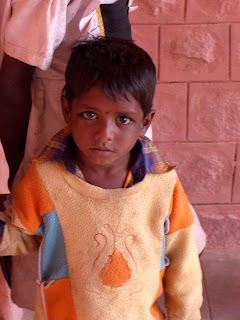
One small girl, maybe seven years old, is fearless for her extraction. Braver than I would ever be, tears slip silently down her cheeks. Others have terrified themselves before they ever step into the room. I hand out several tissues from my pocket Kleenex pack to little ones, to staunch the flow.

Most visits are uneventful. The doctor’s kind face and words assure them nothing major is wrong, and he hopes to communicate that a little brushing would go a long way.

As the day wears on, with beautiful weather, of course, now that we are leaving (we learn later after relocating that the terrible rains returned after we left, eventually doing a lot of damage), the camp draws more patients than we predicted, over 550. It becomes a bit of a social carnival. Old friends from neighboring villages are seeing one another and socializing for the first time in a while. Kids yell and play, dogs sleep in the shade, and a cow wanders aimlessly back and forth through our “waiting room.”

A group of adult males, clearly the bigwigs of the village, makes the rounds, inspecting all to be sure they approve. They move in a pack of six or seven, like teenage boys banded together for communal strength and sense of importance. They decide to see the dentist (and I am told later, they had decided to see other doctors as well). I take a bit of perverse pleasure in making them wait their turn, behind, and this is scandalous, women and children who were there first. I am unfazed by their yelling and pushing—if they want to see Doctor Vivek, I am happy to admit them…in their turn, and not before. They are shocked and laugh derisively. Surely I am joking. An imploring, stooped over “handler” straight out of Central Casting (his role would have been played by Peter Lorre) translates for me how very important they are and how men never wait behind women. I good-naturedly assure him they will absolutely be seen…after these patients… I won’t be winning any popularity contests here among the big dudes of Sukwasi. Additionally, and almost as chafing to their sensibilities, I only allow them in one at a time. Separate from the back-slapping machismo of their pack, they are all nice, easy guys, grateful to be seen by Dr. Vivek—they’ll put back on their jester’s faces when they go out into the sunlight, but in here, the fear of pain is the great equalizer. In later conversations, I find many of the others in our group had similar experiences with this group, with a similar insistence that they wait their turn.

In the afternoon, a woman older and more gnarled than the trees is carried into camp on a litter woven of rope over a crude wooden frame. She sits on one hip, her sari tucked around her sunken eyes, peering out. Her bracelet-bangled wrist is surely too thin and delicate to support the weight of her barely-there body. Her bones are so small they seem better suited to a bird. She is, we are told, the oldest woman in the region. Soon after, a young boy is carried in by a neighbor/father/uncle in the middle of an epileptic seizure. Everyone is helpless until it ends and the tremors fade. Everyone is pretty much helpless after that as well…

I hear second-hand that Charlene, our ER doc in our group, said something to the effect of, “If you could see the amount of typhoid and other extreme diseases that we’ve seen here today, you would dip yourself in a vat of Purell and never come out.” She said she saw things today she has only read about in textbooks.

It all strikes me as brilliant. I realize that had my life gone another way I could have found great satisfaction in work like this…Doctors Without Borders or a similar organization. It feels so fulfilling to definitively touch and improve another life, immediate evidence of your efforts in front of you. It is hard, long, and amazing work.
After this marathon day, we jump on an enormous bus much too large for our group, air conditioned, plushly upholstered, weirdly out of place here…and spend the next many hours driving to Dundlod Fort, fleeing Mother Nature.

We have so much time to reflect on this huge day, talk, space out, watch the tiny towns rush by, sleep, listen to iPods in our private little worlds, etc. It is, to me, both a letdown and cathartic at the same time. I’ve been so externally focused for the last many days, that it feels selfish to be inwardly turned. I’m surprised, but not shocked, at how satisfied I feel. I also feel woefully inadequate at not being able to do more.

I stare out the window and find myself jealous of the men clambering on the tops of trucks and buses—dozens on the roof, holding onto…what? A loose screw? Enough of a steel rain channel for calloused fingers to find purchase? Each other? They are bundled in scarves and shawls of beige and cream (so unlike the brightly dressed women), their faces wrapped against the wind and sand. I think it would be fun to ride on top, but of course for me it would be a lark, a choice, not a necessity to get to the day’s difficult work…here I am in air conditioned comfort sipping my bottled water wishing I was in even more in the elements. When we take the jeeps to schools or goats or medical camp, I always sit in the uncovered back section perched on the steel rail. There is sometimes, of necessity, three of us in this tiny roofless bed of the jeep—barely room for our feet as we sit on the rail, our knuckles white from hanging on as it bumps and tumbles across rutted roads and desert floor. One day I take to standing alone in the back, reaching over the cab to a bar on the roof of the driver’s compartment, my head over the roof getting the full brunt of the wind of our velocity, the small Red Cross flag whipping next to my right ear. A big jump will jostle me but I love it—it feels right to have the wind in my face, and some rain too—it feels somehow authentic. There I am again searching for the root experience. It’s actually just me being a kid, wanting to inject more adventure into the adventure, even though the adventure quotient is already bursting at the seams.

A NEW HOME

We arrive at Dundlod in the dark. We drive through the huge arched gates in the fortress’ walls and climb down from the bus into the hot night air of an external courtyard. Through another internal archway and corridor decorated with large decorated horse statues, and across a large lawn, we are met with much pomp and circumstance. A heavy drum is rhythmically struck and finger cymbals ping. Torches are lit on either side of a grand outside staircase. On either side are two mounted and fully decorated horsemen astride gorgeous, bedecked Marwaris. At the top of the stairs stand regal Bonnie, much more the prince here than he was out at camp. Attendants wave fans on either side of him. We are beckoned up the stairs where we are presented with flower garlands over our heads, and Puja blessings between our brows. It is all so opulent-seeming and grand it takes our breath away, as well as our grumpy moods. We are shown the regal waiting chambers of the ancestral home with intricate furnishings, archways, delicate paintings and art, and diaphanous draperies. The mezzanine level of arched portals is the “Ladies Gallery” where young women can spy on proceedings, and potential suitors, below while remaining chastely hidden. It is an ornate, museum of a room.

We are led through another external corridor to a smaller courtyard where a fire pit blazes, and THE BAR IS OPEN. We descend upon the bar like vampires. Two rolly, polly, outrageously frisky black Labrador puppies tumble over each other for our attention, and we tumble over one another to try to get their attention as well. We are led to our rooms to change and come back down for dinner. It is a bit of a shock to be indoors. My room is simple and large, in a separate building from most of the others, with a huge bathroom and a toilet that won’t flush, but all is well.

Dinner seems like manna from heaven, with more drinks, and we all drift away exhausted to sleep on thin mattresses amid walls not made of wet canvas.

MARCH 2, 2007

Five of us who were having real troubles are able to change horses now that we are at the stables this morning. I feel guilty for breaking up with Manisha, but my new love, Ujjuwala (Ujju) is a dream come true. She is a dappled grey mare. She has less obviously scythe-shaped ears, and Alexander thinks she is a different breed. She’s definitely a good deal larger than Manisha was, and a much easier ride. She does not, however, want to leave the paddock area. I get on, and she stands steadfastly still. The group files out and into the surrounding open land…and she stands steadfastly still. I kick and cluck my tongue and shift my weight forward like trying to get a sled over the snowy lip of a hill, and she stands steadfastly still. Finally a groom comes and takes her by the bridle and walks us to the edge of the fence…as soon as we are past, she happily runs along to catch up to the group and is trouble free—she just didn’t want to go. Once we were committed to the day’s ride, she was all in. Her gaits are gentler but still rapid-fire, her canter fast and fun. I suddenly have a whole new relationship to the ride on my new, wonderful mount.

This is a long ride day, but will ultimately end back at the stables and we will sleep again at the fort, so we make a large, seven-hour loop. The terrain is very different here. There is lots of green acreage in geometric fields divided by long stretches of scrub desert. We even see some sprinklers watering crops. The two major crops we ride amid are wheat and mustard. Between property and field lines are dirt lanes buttressed by piled hillocks forming walls about three feet high. Lots of scrub and bushes also line some of these lanes, and it is like a long country ride until we break into open desert. We pass through small villages a far cry from the ones we knew in the previous region. Here there are occasional power lines, water troughs, dogs, glass windows, and still the kids everywhere, shouting to us, waving. Shy women peek out from under veils, the occasional tinny radio sound of recorded music reaches our ears, there’s even a shop cart here and there with long strings of shiny foil packets of beetelnut/tobacco hanging like chrome streamers. It is a world away from the deep desert, and dozens of worlds away from home.

I have been smitten since our first riding days with the kids who are so fascinated by us in each village we go through. I love the borrowed snippets of language as they hang over walls like Charlie Brown and Linus solving the problems of the world. In this region, they call out conversation openers they’ve picked up (or conversation closers, as many times we are greeted with a very cheerful “Goodbye”). “Hello.” “What is your name?”
I respond with “My name is Andrew, what is your name?”
This is hysterical, and met with, “Hello What is your name?”
“Andrew. What is your name?”
“Hello. What is your name?”
and so it goes.
“Good Morning” was a popular phrase, no matter the time of day, but no more awkward than my clumsily said “Namaste.”

We stop at an Ashram for lunch. We are on an elevated rotunda platform overlooking a green, sloping field. Lunch, as usual, is great. We split off, a few sleep on the pads, a few read books, a few explore the buildings of the Ashram. I find a staircase to the roof and look around. Lisa is up here snapping photos with an enormous lens. We seem pretty mellow, the whole group. I personally am feeling a little defeated by the weather and abandoning our intended journey, and at the same time, trying to be present to the journey at hand. I feel relaxed and peaceful, and look around to the sunburned faces, liking everyone so much.

Some local boys begin to beat a drum and play down below us. It is jarring for those who were trying to sleep, but fun. Our horse and kitchen team has loosened up now that we are on their home turf. “Excuse Me” (his real name is Salim, but he loudly bursts into whatever conversation is going on with an “excuse me” whenever he brings or takes away any item) and “Smiley” (whose name is Suresh, and has the most amazing smile in the world—he is beautiful and knows it and knows the world watches him and all his polite mischievousness), Prakash, and some more of the horse gang begin to dance a bit. One asks for the drum to be passed up to our level, and plays as a few others sing. Salim gets more and more animated—the first time we’ve seen him open up—and swivels his hips, slow motion bobbing up and down to the beat. Suresh is emboldened and joins, androgynous and quite the performer. Their military outfits seem like they could be nightclub costumes as the guys begin to lose themselves in it. Too soon we are told to get ready for the second half of our ride, and we break our lunch camp quickly to ride out the afternoon.

Back at the fort, we have been joined by Bim, a smiling, jovial character of some import in the community. Bim (pronounced “beam” or Bim-jee as Alexander calls him) holds the same job title as Sunayna, and has just completed a several-day ride with another group, so is joining our group. He is a great addition. He wears a turban that fascinates us all the more as we watch him wrap and re-wrap it for our entertainment. Tonight is the night before Holi, a two-day national holiday, and the entire town will turn out at a central square for entertainment and a beginning festival before Saturday’s religious celebration and Sunday’s wild secular celebration. Bim is one of the performers. We ask if we can come see the show.

After dinner, those that want to are walked into the center of town. We are waved through the ticket-taker’s line and into a large square. There are hundreds of men seated on folding chairs on all four sides of a squared off central performing space in the dust. There are only about 35 women present anywhere we can see, all sitting on the ground in a separated section—the women in our group are the only ones allowed chairs. Ours are the only Caucasian faces anywhere. No kids–it is late, almost midnight. I love that this is the exact opposite of a tourist experience—we just happen to drop in on the local festival that would be happening whether we were there or not. Overhead are strings of triangular flags like a used car dealership. In the center of the performing space is a stack of speakers pumping out the distorted, too loud music and announcements we’d been hearing during dinner up at the fort.

Bim is sitting in a section of seats and gets up to lead us over—he seems pleasantly surprised we showed up, having not expected it. I sit next to him for a while. His English is excellent but there are still gaps in our understanding of each other. He tells me there are performing troupes from many surrounding villages here in a competition, and it will go on until 3 or 4 in the morning.

Bim gets up to perform with his group. There is much fiddling with the cassette deck trying to get music cued up. An elaborate pantomime and series of songs begins starring three characters…Bim as the leader and narrator (none of it is in English, so I am guessing) and a young male protagonist, and his lovely veiled, seductive wife—an extraordinarily tall man in very bad drag. It seems a comedy as the audience of men cheers and laughs at the over-the-top Vaudevillian performances with much eyebrow raising and clearly double entendre jokes. It goes on and on, but we love seeing Bim. Eventually he comes back and sits down with us, congratulated heartily by the crowd as he walks over. Another village’s troupe is preparing, fighting their own battles with the sound system as their rubber faced leering leader and woman in drag prepare for more of the same. As it goes on in much the same fashion, we eventually excuse ourselves since the yawns of exhaustion are taking over. I fall asleep in my bed serenaded by the cheers and laughter of hundreds of celebrants.

MARCH 3, 2007

Today we will ride a long day, and relocate to a camp outside the fortress. The camp is actually quite close to the fort so the next morning we can begin at dawn and return to the fort before the hijinks of Holi begin. Since part of Holi involves throwing firecrackers, it makes sense to get the horses back to the stables as early as possible.

This is a great day of riding, and I absolutely adore Ujju (her name means “bright”). Her gaits are so much smoother, she doesn’t insist on ramming her nose up every other horse’s ass, and she responds to the bridle. I wish there was more cantering. We have all grown more confident, and those of us on new horses are all much happier with the exchange. Great sweeping hills and more crop areas surround us. Several people are sick—we’ve been passing a flu around since, from one day to the next while camping we never had the same pillowcases or towels, and nothing is washed. Curtis and Charlene had staid in bed yesterday but are riding today. We all take a break in shade in a village square to observe some architecture and elaborately painted buildings, noticing the clockwise swastika symbols everywhere. We are so trained to see the swastika as a sign of evil, but when the arms go clockwise, it is the Hindi symbol for the universe (so to in Native American symbology). As we were stopped for a longish spell, Charlene’s horse thought we must be done for the day and rolled onto the cobblestones with her still in the saddle. It happened once or twice before to other riders—the horses are encouraged to roll after sweaty rides as a method of cooling off in the desert—the dust, as any elephant will tell you, cools and helps sweat evaporate. Charlene already had some knee issues, so a horse rolling onto her didn’t help, and she finishes off the day in the jeep.

I can’t quite figure out why camels growl. It is the low, threatening, guttural growl of a large predatory cat. Is it because they are threatened by the horses? Certainly Manisha, and later, Ujju, get a little dance-y when we come upon them. Ujju, in fact, prances a little sidestep at every blind corner in a village as we round high walls. What does she know that I don’t? A charging quartet of sheep with cobblestone clattering cloven hooves spooks her into a few paces of jangly running before we both exhale, and, I like to think, laugh at ourselves. Stupid sheep. Maybe that’s the camel attitude as well. “Stupid horses—I’ll growl and wag my prodigious lip at them, baring my teeth—that’ll show ‘em. Check out these big brown teeth, little horsey. Ain’t nobody stuck a metal bit in MY mouth to lead me around, like some idiotic equines I know. Ha. Bit bitch!”
With all of her wisdom, Ujju lowers her heavy lids and mutters, “Whose got the ring in his nose so that guy can yank you around like a puppet, you one-humped mess?”

Lunch is at a shrine-like water well with green fields all around and a decent amount of shade. I keep saying I wont nap at lunch, but since we take a few hours to let the heat of the day pass, I always drift off and my energy drains out like air from a slow leaking balloon. Women in impossibly bright saris and veils carry enormous bundles of picked green crops on their heads. We see so much of this, as women balance huge loads of laundry or bundles of sticks on their heads appearing far too delicate to ever support the load. A camel we passed was pulling a wooden plow, digging furrows in an arid field. A mother and her small children pass us with a donkey cart the size of an SUV…the dinky donkey seems no larger than my German Shepherd at home.

After the long day we get to camp and enjoy sunset tea amid a few trees as a full moon is already making its way into the sky over the tied up horses. Tonight will be our last camp night, so it is the staff party to fete the boys and buy them many, many drinks—they are truly amazing and work so hard under such adverse circumstances.
Our campfire tonight turns into a singing, dancing, drum circle. The boys eventually coax us up a few at a time to dance and writhe around the fire with them. My back has been killing me lately, but I swivel and hip-thrust as best I can. I will miss these guys so much, and we all begin to wrap our heads around the fact that our time here is finite.

This is also the first night of Holi, the Festival of Colors. Tomorrow is the drunken, aggressive, color-throwing Bacchanalian free-for-all. Here in our little camp we can hear fireworks and celebratory gunfire from at least three different directions, and a distant village we can hear but not see is bursting with chanting and song. It is an amazing experience.

Holi comes from “Holika,” the bad sister in folklore who is impervious to fire with her magic cloak. She tries to kill her good nephew by taking him into the fire, but the cloak falls from her shoulders and covers him so he is saved and she perishes. Holi commemorates the triumph of good over evil and a day when your sins are burned away in the fire. The story is much more elaborate, and told differently by each person we hear, but is fascinating. I’m unclear where the color thing comes in, but I know that colored powders and sometimes liquid are thrown at people all day making an incredible mess and drunken pastiche of tinted dust. Bonnie wants us back safely at the fort so we’re not accosted. Most of us, of course, want to participate. We’ll see how it goes, and fall asleep to the moon as bright as daylight and explosions of celebration.

MARCH 4, 2007-HOLI

We wake at dawn, covered in dew and cold, and have a quick breakfast. One of the boys comes around with a pie tin of bright green powder and draws a thumbprint of color across our heads—for us Holi has begun.

Our ride into town and the stables is uneventful—no boys chasing us with firecrackers to freak the horses out.

We get to the fort and sit in woven cane chairs in the courtyard, hearing a din of noise outside the walls. Since Bonnie is essentially the crown prince of the region, villagers begin to trickle in to pay their respects.

Salim and some more of the boys turn up with red and green powder and we all get smeared with fists full. Doc is a particular target and is covered in no time. Alexander, of course, is also a prime target. It gets funnier as more and more powder is smeared across cheeks, on bare arms and legs, and all over my evidently irresistible bald head. We all go and change out of riding gear into clothes we don’t mind getting ruined. I come back in shorts, t-shirt, and flip flops, my camera stashed away in a cargo pocket, hoping it won’t be ruined. We get in on the act, calmly at first.

The rest of the staff has turned up, loud and drunk and stumbling in one many-armed, many-legged, ragged-voiced, color-smearing mass. They stumble, sing, fall into each other. They pick on the two tiniest men, one old and one young, and pick them up on shoulders, hold them upside down and pour alcohol down their throats. They can barely stand and walking a straight line is well outside the realm of possibility. They each smear more color on us as a greeting, as we do them. By now there is purple and hot pink and some gold. One old guy gets out of hand and throws fistsfull directly into other people’s eyes. As village elders come to visit Bonnie, they bend down to touch his feet and are anointed calmly with powder.

Caroline, while dancing, had her knew buckle and go out from beneath her. When she gets home, she’ll discover she tore her ACL and has to have surgery and many weeks of rehab.

Several of us insist we are going out into the village. Bim gathers some of the guys and they escort us. Candy and Rebecca have donned turbans. One of the jeep drivers, Anil, a tall, mustached man, is in full pink drag with veil and fake breasts that he takes every occasion to rub up against us in a shimmying dance. Someone else produces a drum. We are a ragtag parade as we head out of the fortress walls.

Outside, it is primarily calm. It is not yet noon, but many people are already sleeping off terrific amounts of drinking. We drum and dance and chant our way up and down streets. People peer over walls and out windows, and our coterie grows. Louder chanting and clapping accompanies a good deal of horseplay, dunking each other in water troughs, trying to trip one another. They treat us like VIPs, getting us to dance and twirl with them, but never get too pushy. Rebecca, being petite and young, is lifted on someone’s shoulders. Patriarchs come out of some houses to greet us and shake our hands and smear us with their own colors…at least Barry and Curtis and I, I’m not sure they do so with the women. We dance and chant on, dogs and goats scurrying to get away…a cow is covered in colored powder and annoyed by our noise. There is enough laughter and yelling and joy to last for days. We pass an empty tour bus and later look up to the roof of a Haveli Museum and see the entire busload of tourists all feverishly taking our pictures. We eventually wend our way back to the fortress, and people drop off. We eat lunch in the courtyard covered in our colors. Eventually the drains of our bathrooms are challenged to wash away color after much effort and scrubbing. Lynn’s beautiful silvery hair has a swimming pool chlorine-like green glow, and Merilleon sports a certain shade of purple in hers. We notice color behind each other’s ears or backs of arms. I will blow my nose with vivid hues for days. The afternoon has the entire town asleep and I wander up a stairwell and walk along the narrow top of the fortress walls. There are two huge monkeys sitting on a balcony outside a window, enjoying the quiet and masturbating to their own reflections. A few kids walk by in the heat and look up to me, shading their eyes and waving.

Dinner is quiet—many of us napped or simply hung around, relaxing. It is Marianne’s birthday, and she wants to get into some sort of trouble. Most of us are exhausted since the day began earlier than most, but we agree we will go up to the roof of one of the fortress towers, bring a couple of bottles from the bar, and toast her in the bright moonlight.

It is a scene from a movie up here. We’re pinned by the brilliance of a just-past-full moon, the view of the town’s roofs like a backdrop in the blue-silver light. We’ve dragged out a couple of mattresses and blankets. Like Junior High School kids, someone gets the idea we should try to find someone to sell us some pot. We eventually dispatch Bim to the town to find “ganja” while we drink and laugh more and more. A few people get sassy, a few grow quiet, a few outrageous. It is our bonding and our getting ready to separate night rolled into one. Bim returns and we pass around sloppy joints filled with nothing more potent than tobacco, but feel naughty anyway, even if we were ripped off. A few women try to psychoanalyze Alexander—I dare say it is neither the first nor last such attempt on Relief Rides—he takes it well, pretends to be wounded a bit but isn’t. Lynn breaks out into a sad, haunting version of “God Bless the Child” that if you had asked me I would have said everyone would mock, but instead each of us grows quiet and introspective. Laughter comes back with much stumbling. It is a rounded staircase that wraps the outside of the tower that takes us up here, with no railing. After many of us, myself included, go off to bed, Marianne falls off the edge of the stairs and is caught, barely. She severely injures her knee and will be taken to the hospital the next morning, and Alexander, her catcher, wrenches his back. Her trip to hospital is one adventure I must say I don’t envy as we drop her off (attended by Bim) amid the throngs of people waiting, sitting, lying on the hospital steps. Since Bim is of some import in town, he gets her in ahead of much of the crowd, but it must be quite the experience anyway. Good times…more drama. Happy Holi.

MARCH 5, 2007

Before lunch, we jeep from the fort to two remarkably different schools. The first is a magnet school, private, and geared specifically for untouchables, who in most communities would drop out of school due to the social stigma of their caste. There are learning tools, pristine classrooms, landscaped flowerbeds, fresh paint, and a very upscale feeling to the place with very dedicated teachers and great kids.

The second school we visit is an all-Muslim school. We arrive unannounced so there is a bit of explaining to be done as a few of us take over the principal’s office to stuff pencil boxes. A few older boys, teenagers, are sent to help and they are genuinely helpful and curious, with great English. I stick around in the office talking with them as we have enough people to do the worming and handing out tasks. After we distribute supplies to the student body and are leaving, I am hugged by several of the older boys who were helpers, and they ask if I can stay and talk. I wish I could, but don’t know how to get back to the fort from here. There is some quiet conversation among our group that I overhear that distresses me and is reflective of our American misunderstanding of the Muslim community. After we get back for lunch, someone in the group talks about how rewarding it was to look every Muslim child in the face so that they would know that these supplies came from America and that all Americans aren’t evil. This attitude pisses me off, having spent one of my most enlightening days in Delhi for several hours in the very intense Muslim quarter of the city. It just seems so naive to project fear or hatred onto these kids who are definitely NOT feeling it…it clearly comes from our own fear and hatred, though I know the comments came from a genuinely grateful place and the day served as a revelation to some.

The Mark Twain quote that is so overused is apt, “Travel is fatal to prejudice and bigotry.” I wasn’t aware I had a lot of prejudice and bigotry to burn off. It turns out mine is more a reverse prejudice against my own type…affluent white tourists. My patience is in the gutter for ugly Americans (not really anyone in our group, just the arrogance of tourists in general)…for the locals I have nothing but fascination and sometimes envy. When I was growing up, the most offensive thing you could call me was “faggot.” Now I think it is “Tourist.” It chaps my hide much more. Always when I travel I have an obsessive searching need for “off the beaten path” experiences, I flee obvious tourist spots like the plague. Just saying the word tourist, my lip curls into an Elvis-like, inadvertent sneer. Perhaps it is connected to and a logical continuation of my earlier passion for acting…Wanting to be completely immersed to see what another existence is like. What’s it like over there in your head? How does all of this look through your eyes? What does it sound, taste, smell, feel like? How did you grow up to get here, now? What makes you happy or harried or hurt?
Unless you are an arrogant S.O.B. demanding someone “Talk English, Damnit”…in which case I don’t want to know a thing about you, except how soon you are leaving.

After a great lunch at the fort, we walk to a Sanskrit school. It is a school holiday for these students, so many of the kids are at home, but there are still some here. We leave supplies and medicine for those who are absent.

In the late afternoon we go for a short ride, maybe three hours. It is our last ride, and I am incredibly sad. We stick together as a large group and do some cantering—more than the Zen group had managed before, and less than the Impatient Ones, no doubt—it feels great to have a ride with all of us together, and I think everyone had a good time. My back has been killing me lately, and on this ride it is excruciating (I learn when I get home that I have a herniated disc) but wish we could go on and on for many more days. It kills me to say goodbye to Ujju, and I will think of her and of Manisha so often, feeling so lucky to have had these amazing partners for this journey.

We get back to the fortress, and I am feeling lousy. As the sun sets and we are drinking chai, I am achy and sore. I begin to shiver uncontrollably though I don’t feel particularly cold. Then the chills set in and I shake even more, teeth chattering. I excuse myself and go to my room, having trouble making it up the ramps to the second floor and opening the padlock on my door with the tremors that are manifesting. I take a hot shower and lie down for a bit. At dinner time I go down to the interior courtyard and just order water from the bar—this signals everyone something is clearly wrong if Andrew isn’t having a drink! I ask Rebecca to convey my regrets for dinner, and tell her I won’t lock the big wooden doors to my room in case anyone needs to get in, but I have to go to bed.

I get back to the room and put on more layers of clothes, sweats over pants and more shirts, and climb under the covers. My body hurts everywhere and I cannot get warm. I don’t remember a time I’ve felt so painfully feverish in my life. I actually take one of the thin mattresses off of the two single beds pushed together to make a King, and pull it over me as another thick layer. Barry checks in and Alexander brings Salim up to my room to see if he can bring me food. I am incredibly touched if not incredibly hungry. I ask for just white rice. Barry and Salim return with rice and some other food that I pick at. They head down to the group and I begin one of the longest nights of my life. I sleep fitfully, tossing and turning, impossible to get comfortable—it feels like I am sleeping on boulders, freezing cold boulders. Evidently I drift off, for when I wake it is getting light out, and I have soaked sweat through the many layers of clothes and the blankets. I am drenched, but feel remarkably better. It feels a bit like a miracle to me as in some of my feverish dreams, I was convinced it was all over. I had malaria or typhoid or god knows what. In my fever dreams I thought about getting up to write a note to Bob to leave behind since I figured I may not ever make it home, but couldn’t find the headlamp/flashlight that I had dropped and kicked under the bed as I reached around in the dark with one frozen arm out from under the blankets. Drama, drama, drama.